Cooling witness candidate
The actual first-person cooling approach exposed faint, noisy markings on an otherwise functioning pressure needle. The candidate replaces only that dial artwork and its immediate bezel. It keeps the global lighting, camera, material pipeline, framebuffer, slit admission and tank layout.
The original 128-pixel face has a quiet aged-paper centre, heavier engraved ticks, five numbered stops, a return groove at 38–48 and a separate dark red high-head groove. Wear follows the handled rim and service edge. A narrow steel bezel and three seated fasteners frame the existing brass casting. The same authoritative pressure continues to turn the same physical needle; this artwork cannot alter simulation or award completion.
Before shows pressure around 47 after the actual relief office. After shows the revised instrument at the same physical approach with a fresh practice pressure of 72. The gauge's ticks and distinct grooves are more legible at the real low-resolution footprint. The snapshots intentionally show different readings, not a claim of matched lighting or simultaneous play.
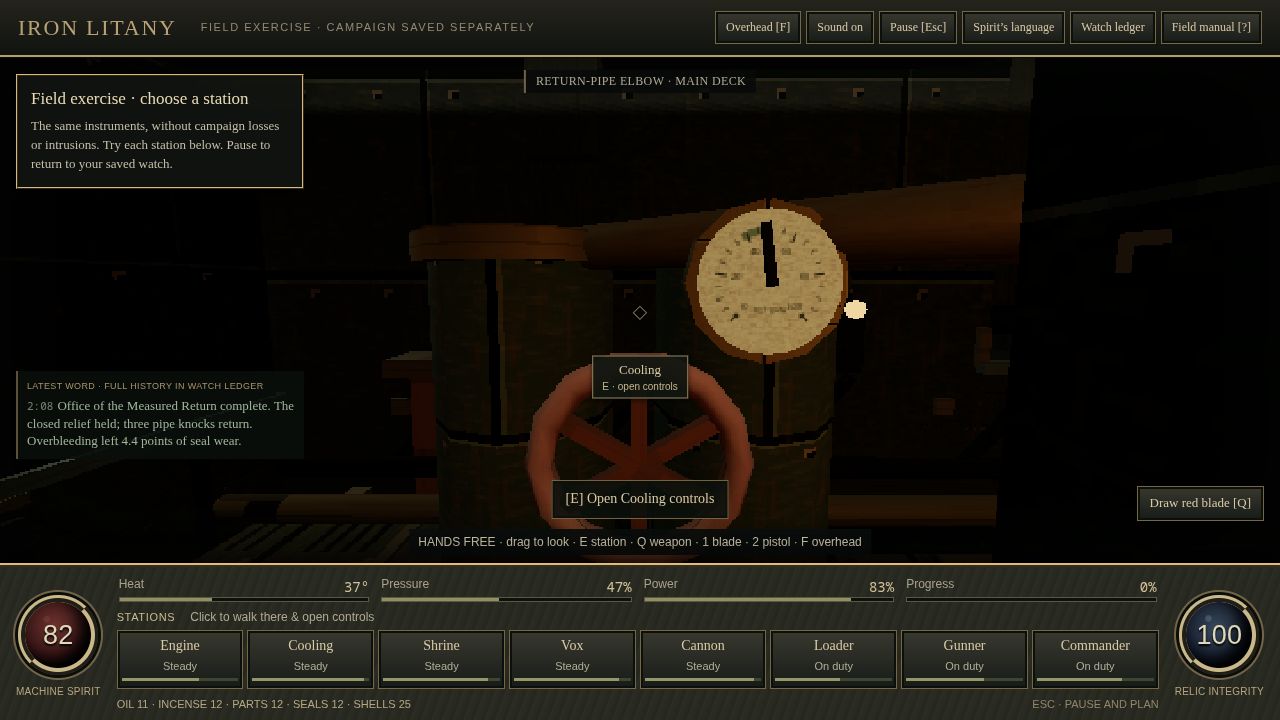
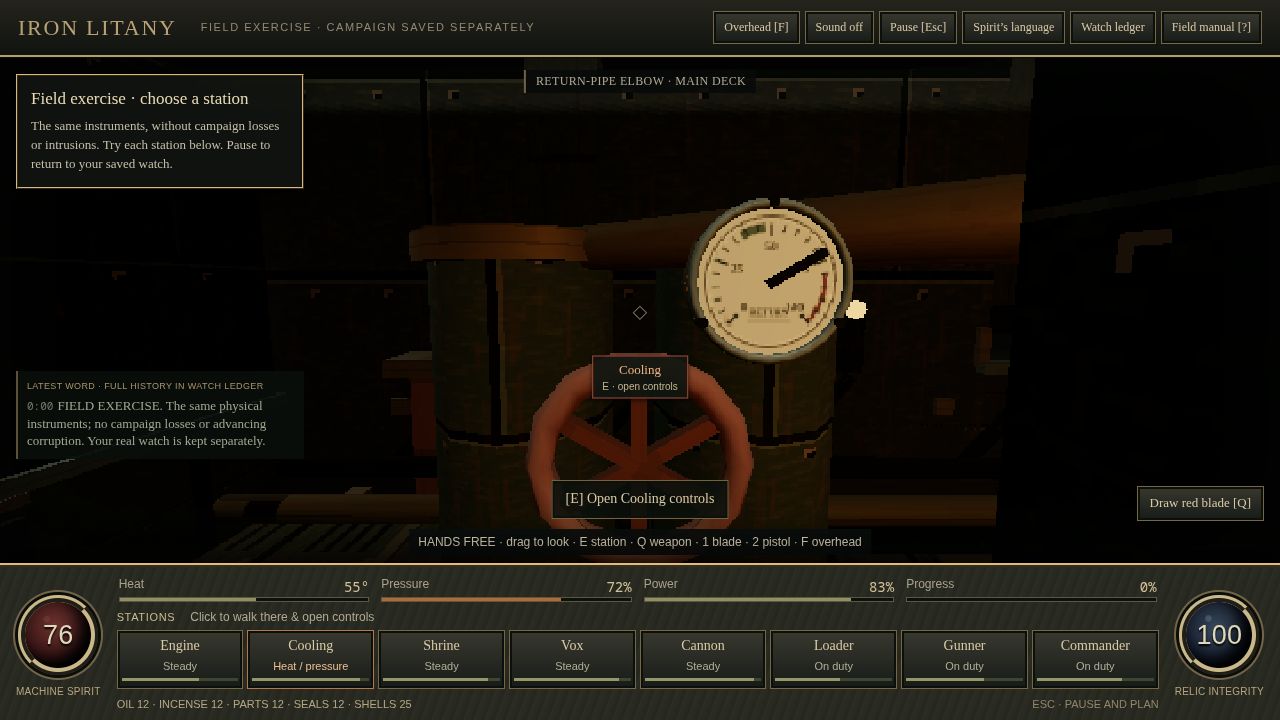
Actual controls completed the previous measured office after overbleed, pump recovery, closing in band and witnessing the return. One oil was spent, 4.4 seal wear remained, circulation was restored and the done-mechanism playback event occurred. The returned filter wheel, surrounding pipes, valve construction, crew and battlefield still require integrated art and motion review. This is a procedural art candidate, not creator-approved Diablo I-quality art or listening acceptance.
Source: dist/game/src/instrument-dial.js and the local gauge assembly in world.js. Provenance is original code-authored artwork; no published game screenshot or texture is shipped. The face spans 0.312 metres inside a 0.36-metre casting. Artwork is generated once into one 128 × 128 texture and adds four static assembly meshes before batching. No new model, media render, recording or external bitmap dependency is required.