Crew runtime art revision 5
5 October 2026. Candidate refinement; actual integrated visual review is still required.
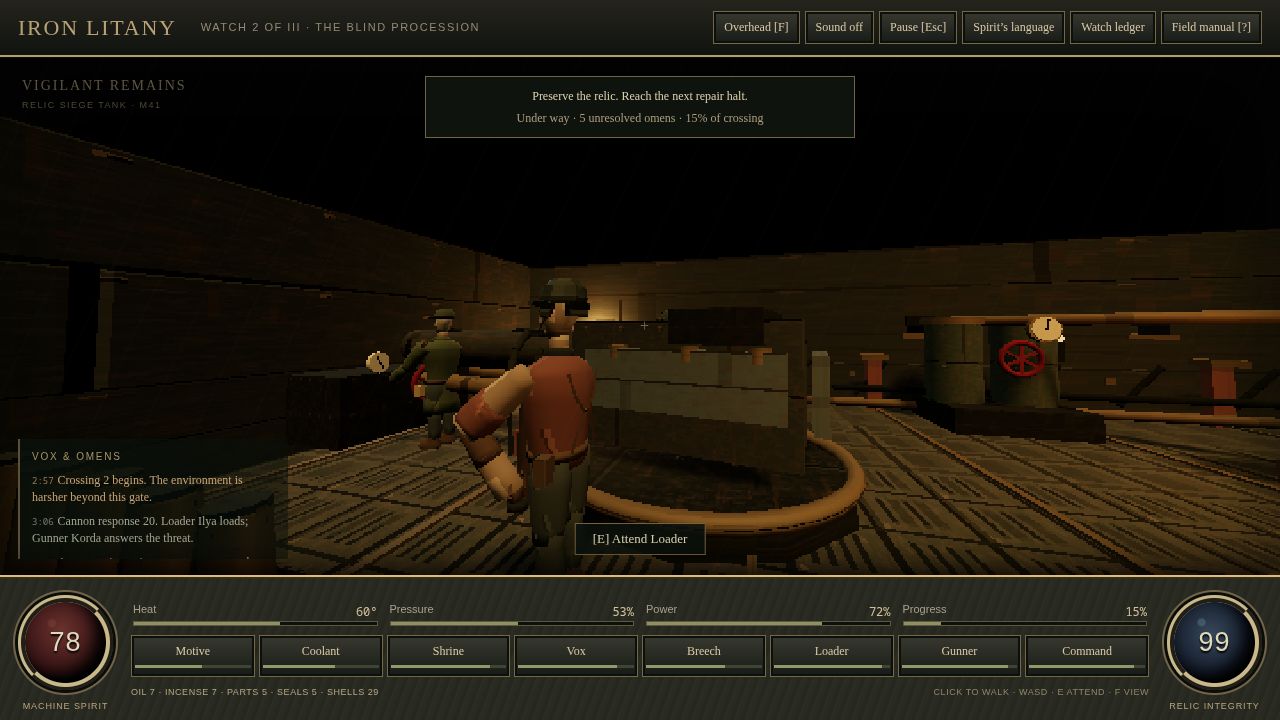
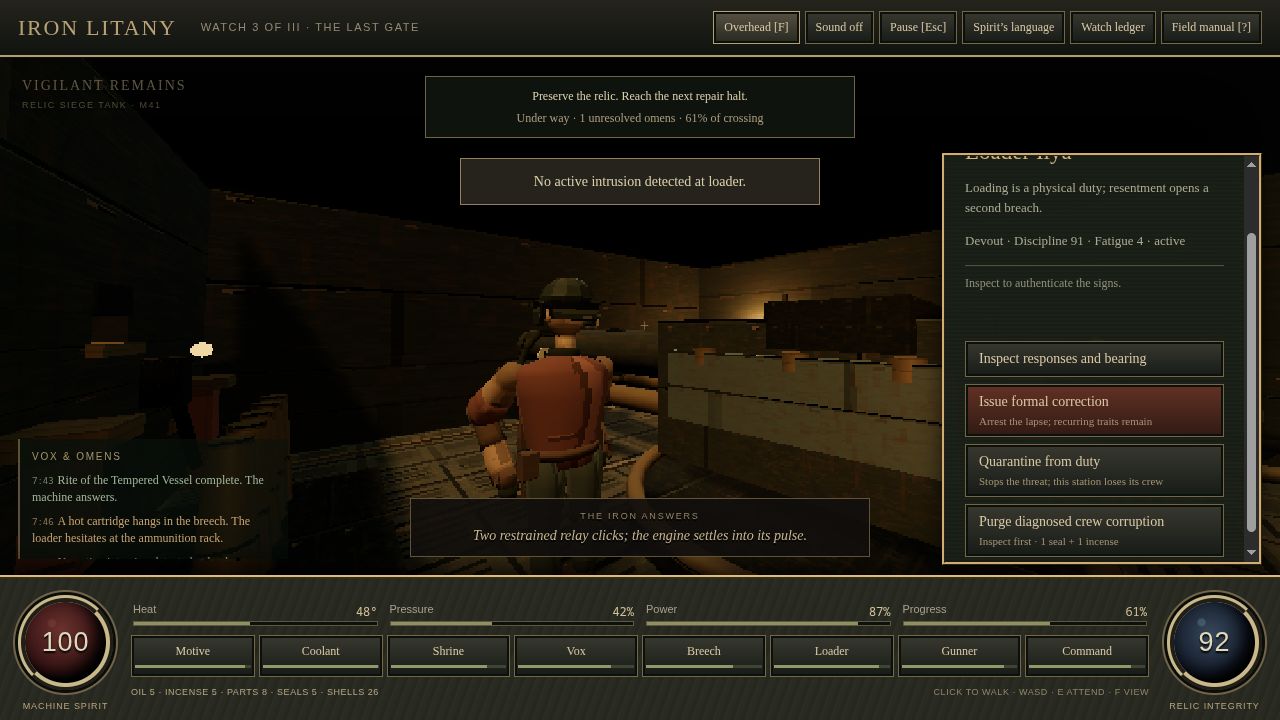
This pass compares the actual v0.2.1 loader approach, the close runtime model study and the direction plate, under the binding art direction. The direction plate remains concept art rather than proof of runtime quality; its expansive visible exterior is also superseded by the creator's later eye-relative slit requirement.
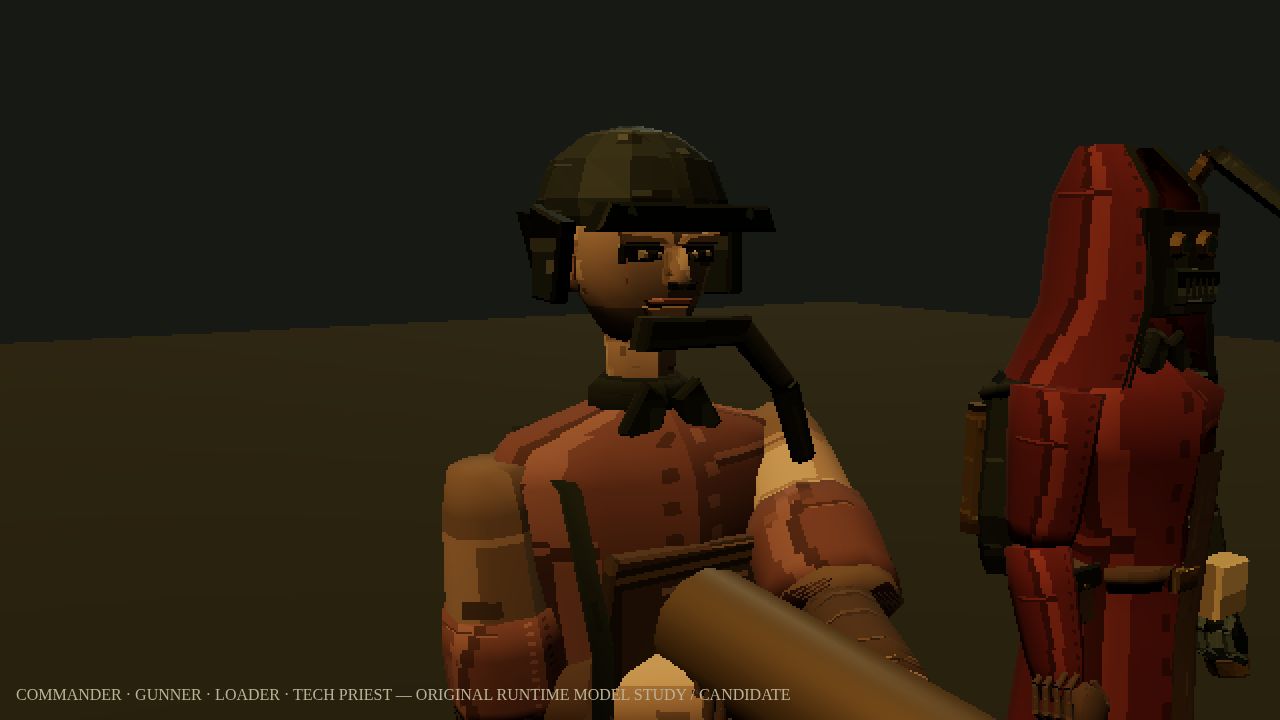
The remaining problems were specific: a broad flat helmet lip and deep ear guards; rectangular eye sockets enlarged by bevels; a short, inflated mid-face; repeated full-height tunic stripes; the same dry response on every organic surface; and a flat apron with little workwear identity from behind. More texture noise or more uniformly subdivided geometry would not resolve those forms.
Authored changes
- The head keeps the existing world-space height but lengthens the face downward, narrows jaw and temples, adds oblique cheek planes, and gives the eyes smaller tapered sockets and uneven tired lids. A subtle lower-jaw surface reads as unshaven skin. Nose, closed mouth and ears remain restrained adult features.
- Small plate bevels now follow their actual depth. The old fixed 5 mm bevel enlarged 1 mm eyelids, pupils and seam plates into blocks. Large machinery and garment contours retain their previous maximum bevel.
- The loader and gunner helmets fit closer to the skull, with a thinner brow edge, a shorter nape and ear guard, and a fastened chin strap. The dome is hollow underneath rather than a solid bottom disc. Its top and overall character height stay at the existing positions.
- Cloth folds terminate at plausible shoulder tension and lower hems, leaving broad quiet areas. Tunic cross-sections are less inflated. Skin uses a restrained, less yellow ramp; small facial planes and arms sample quiet atlas regions instead of repeating the full head tile's brow and jaw bands.
- A second original 256 × 256 data atlas supplies organic roughness. Dry cloth, skin and worked hide have distinct responses, with slight smoothing only on handled leather edges. This shares the existing material and adds no mesh submissions. Metal and optical responses are unchanged.
- The loader apron has a thin curved front and back, a slightly sagging lower edge and a body-following side wrap. Crossed back straps make the work harness legible when the player approaches from behind. The shell, grip, loading state and footwork are untouched.
All geometry and atlas pixels are original code-authored assets. No published reference pixels or reference meshes are included. No global camera, lighting, sampling or grading changes are part of this pass.
Measured cost and integration contract
| Role | Actual unscaled height | Triangles | Isolated mesh submissions after existing batching | Delta from revision 4 |
| Commander | 1.740 m | 3,452 | 16 | +160 triangles; no added submissions |
| Gunner | 1.761 m | 3,784 | 23 | +144 triangles; no added submissions |
| Loader | 1.761 m | 4,066 | 21 | +232 triangles; no added submissions |
| Tech priest | 1.816 m | 2,778 | 20 | Triangle count unchanged; small plate bevels refined |
Heights are measured before isolated static batching. Existing conservative axis-aligned bounds can change slightly when rotated pieces merge, so the table does not represent a new collision shape or a performance benchmark. The added roughness atlas contains 65,536 data pixels; neither atlas is an external download.
The floor origin, positive-local-z facing, shoulder and hip pivots, userData.arms, userData.legs, and loader rig contract stay intact. Loader upper and lower arm lengths remain 0.372 m and 0.365 m. poseLoaderArms still reports unreachable work rather than stretching limbs. Public constructors and animation inputs are unchanged; only candidate art identifiers move to revision 5.
Four focused character/loading cases pass: finite bounded adult anatomy, wrist contact after parent movement and rotation, unreachable-work detection without arm stretch, and ordered shell handling through one real shot. The integrated full-suite check belongs to the combined change after other work is ready.
A follow-up geometric review found the first cheek pieces buried behind the cranium. Their authored tangent now follows the actual cheek slope, with a 1.5 mm plate thickness. Front-ray samples of all ten front-facing triangles on each piece clear the skull by 2.1–5.2 mm at their centres. Triangle count, submissions and overall silhouette bounds are unchanged. This verifies surface placement, not normal-size visual quality.
Required actual review
Root integration must record normal overhead, a front/side loader approach, shell acquire/align/seat poses and crisis recovery through actual player controls. In particular, inspect whether the smaller eyes and fatigue marks survive the real framebuffer, the new apron clears the chest and shell, chin straps clear the lowered respirator, and skin/hide remain distinguishable under the tank's practical lights. No new capture, human art approval, integrated motion approval or sustained performance claim is implied by this document.
Final sculpted/pre-rendered mastery, unique recruit identity, changing injury/fatigue states, driver hand contact and gunner sight contact remain outstanding. This is a bounded improvement to procedural runtime forms, not the finished Diablo I-quality art target.
Integrated observations
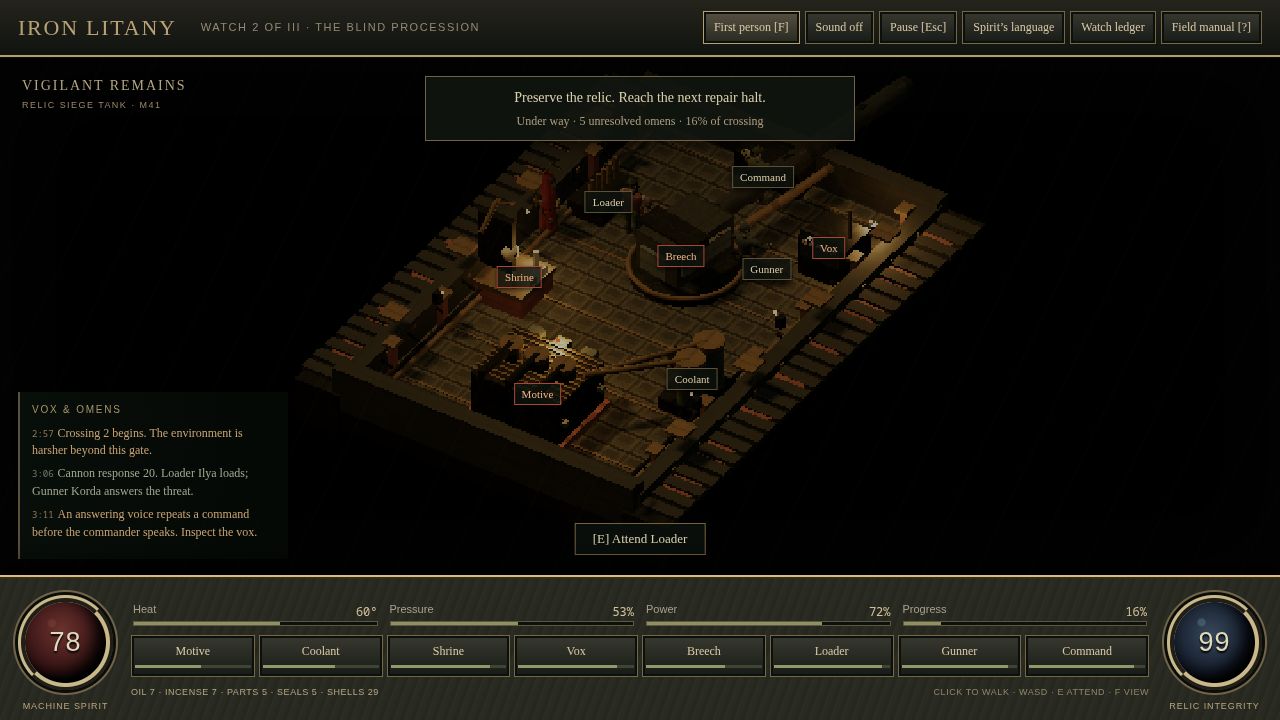
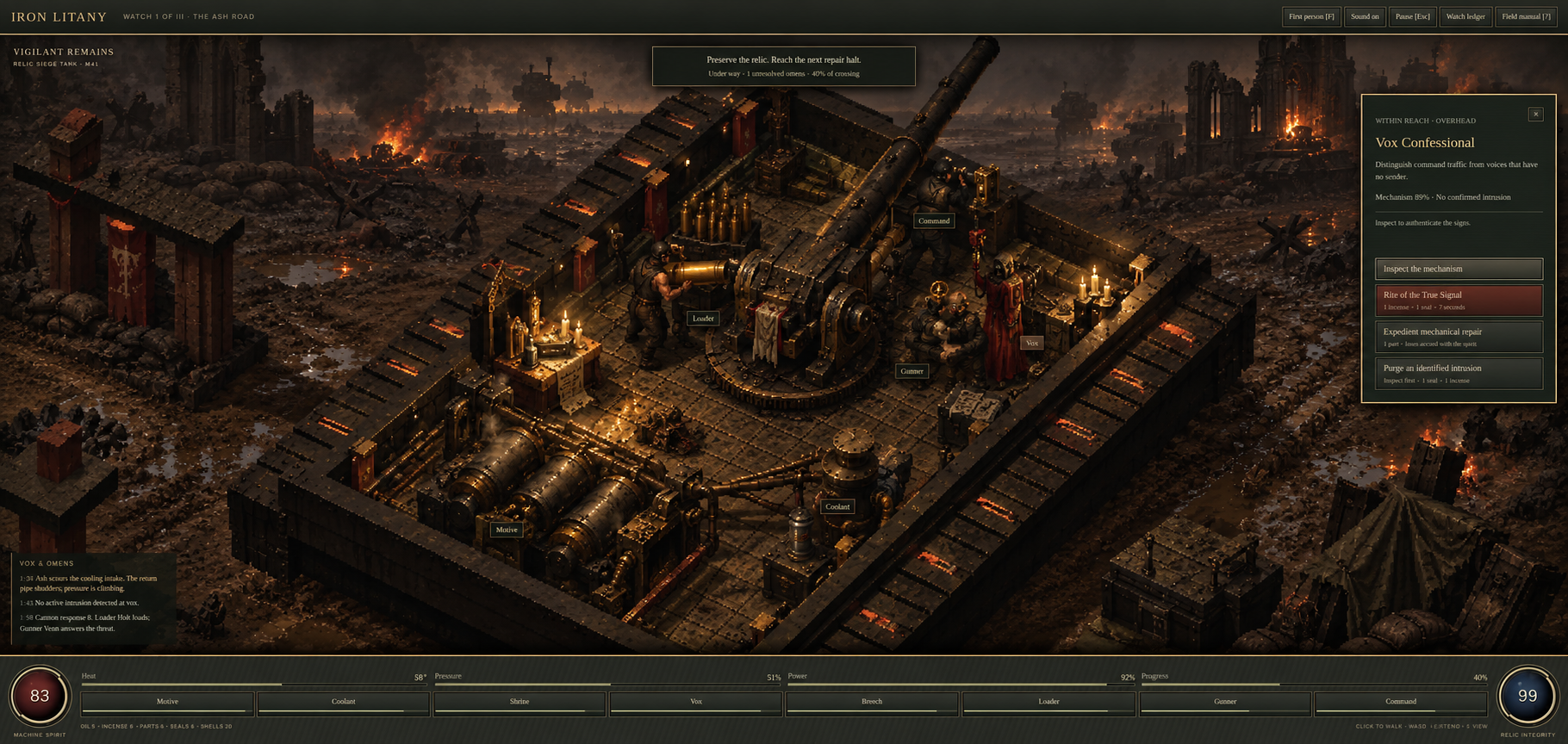
Root actual play reached the first repair halt and replaced all three crew, then inspected Loader Ilya in Crossing 2. Side-aisle frame and overhead frame record the integrated candidate at normal 1280×720. Moving the approach to (-3.45, -1.6) avoids the prior cropped transfer close-up; a whole-cycle inspection-clearance test now supplements the arm/contact checks. Eyes and broad workwear forms are readable at this framing, but the face remains angular, garments procedural, and driver/gunner contact is unfinished. These observations are not final art or motion approval.